

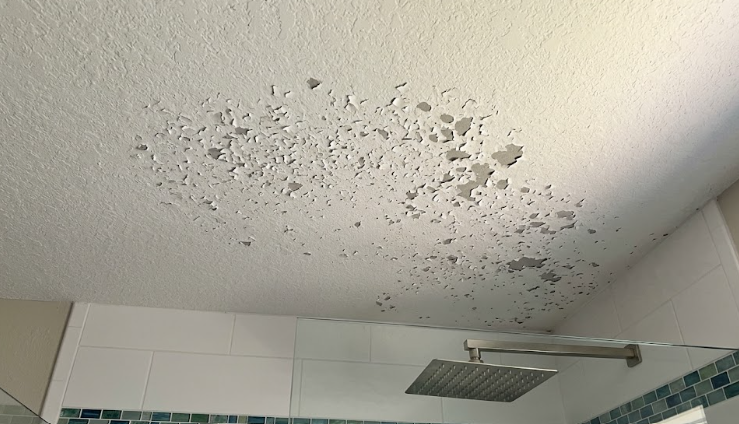
Paint peels on a bathroom ceiling when moisture breaks the bond between the paint and the surface. In Florida, where the peeling starts usually tells you the source: directly over the shower it’s steam; in a ring around an AC vent it’s condensation from cold air meeting humid air; along an outside edge it’s often roof or wall moisture; and a stained spot that keeps spreading is usually a leak.
-
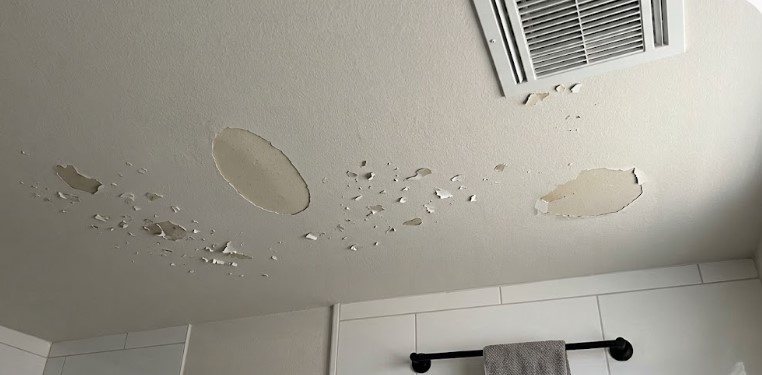
Peeling that started near the supply vent and spread across the ceiling, in a Tampa bathroom we were called to look at - Most advice on paint peeling in bathroom ceiling spaces assumes the shower is to blame. In Tampa Bay homes, the AC is often part of the story too, so the location of the damage is the first thing we look at on every bathroom ceiling repaint.
Where is your ceiling peeling?
Look up and find where the damage started, not where it spread to. Each zone of a bathroom ceiling points to a different cause.
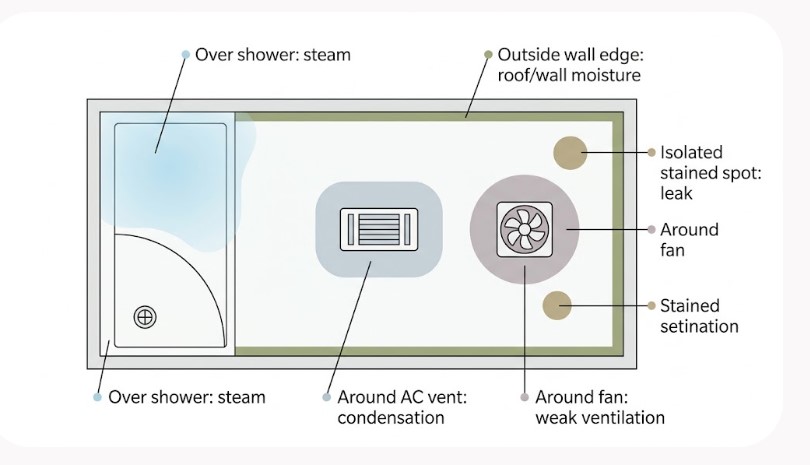
- the five zones of a bathroom ceiling and what peeling in each one usually means
| Where it starts | Likely cause | What we check first |
|---|---|---|
| Over the shower | Steam | Fan and run time |
| Ring around AC vent | Vent condensation | Thermostat and humidity |
| Around the fan grille | Weak fan or duct | Airflow and duct exit |
| Along an outside wall | Roof or wall moisture | Roofline and flashing |
| Stained, spreading spot | Leak | What’s above the spot |
Each zone has its own section below, starting with the one most Florida guides skip: the AC vent.
Paint peeling around bathroom ceiling vent grilles: the Florida AC problem
A ceiling supply vent blows cold air into a room that, in Florida, is often warm and humid, especially right after a shower. When that humid air touches the cold metal grille and the drywall around it, it condenses. The vent “sweats,” water beads up and runs along the ceiling, and the paint around it starts to bubble, crack, and peel.
Two things make it worse:
- A very low thermostat setting, which makes the supply air colder than the room can handle.
- High indoor humidity, which gives the cold surface more moisture to pull out of the air.
If a vent keeps sweating after the humidity is under control, we recommend an HVAC check. Duct insulation and airflow issues are a job for an HVAC pro, not a painter.
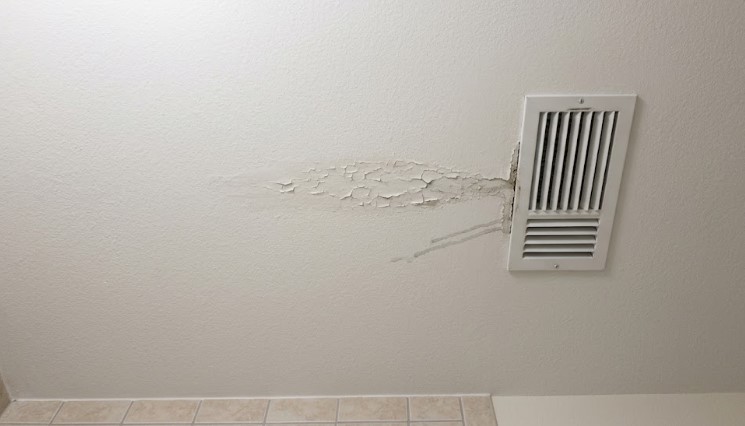
- Cracked, peeling paint spreading out from a ceiling supply vent, with drip lines where condensation ran down the ceiling
For this bathroom, we got a call from a homeowner in Brandon about paint peeling off her bathroom ceiling. We could see it was all bunched up on one side of the AC vent. Her thermostat was at 68 and the bathroom was sitting at 74% humidity after a shower, so that cold air was basically sweating onto the ceiling every time the AC kicked on.
“Honestly, the first thing I do is pull the vent cover off and look at the seal around the duct. If cold air’s leaking into a humid bathroom, you can paint it all day long and it’s just going to peel again.” Russell Peach.
Peeling around the exhaust fan or a light fixture
Peeling that starts at the edge of the fan grille usually means the fan isn’t doing its job. The common culprits:
- A fan too small for the room, or one that’s simply worn out.
- A fan that vents into the attic instead of outside. In a Florida attic, which can get extremely hot in summer, that moist air has nowhere to go.
- A duct that has come loose from the fan housing, so the air never leaves the ceiling cavity.
The quickest check: hold a single tissue up to the grille with the fan running. A working fan holds it flat. If the tissue barely moves, the fan or duct needs attention before any painting.
Ceiling light fixtures can fail the same way. Any opening in the ceiling lets warm, humid air meet the drywall edge, and the paint around it is often the first to go.
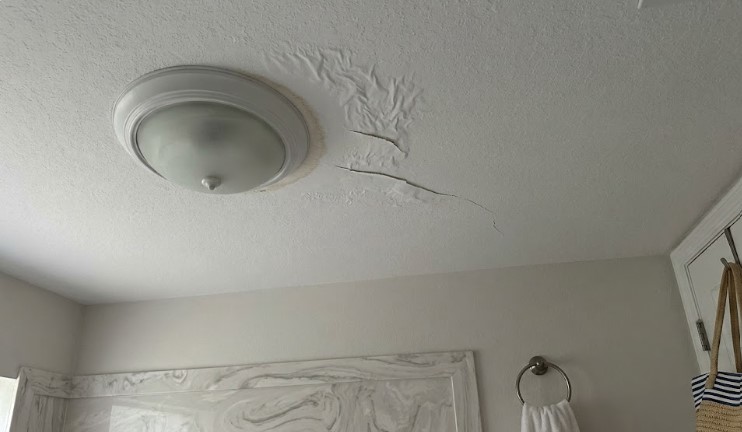
- Paint wrinkling and cracking at the edge of a ceiling light fixture, with a faint stain where moisture has been getting in.
Peeling right over the shower
This is classic steam damage and the most common cause anywhere. Hot water vapor rises, settles on the ceiling directly above the shower, and soaks the paint every day.
Florida makes it harder to recover from. In most climates, a bathroom dries out between showers. Here, the air is already humid before the water even runs, so the ceiling above the shower can stay damp for hours. Peeling shows up as dense flaking in a patch roughly the size of the shower below it.
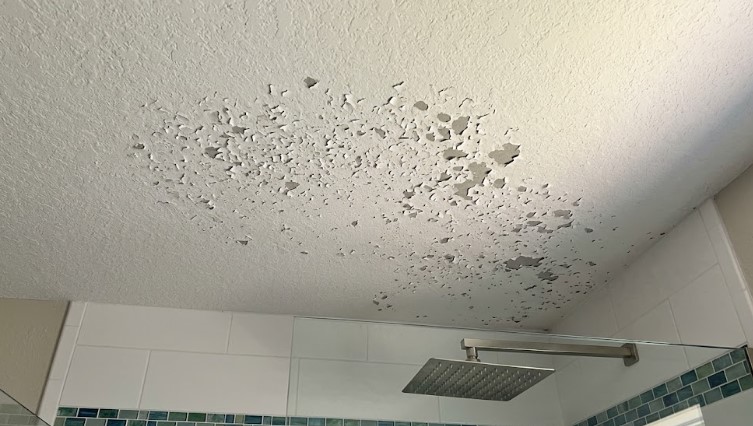
- Dense flaking concentrated right above a rain shower head, the steam pattern we see most often in Tampa Bay bathrooms.
Why is my bathroom ceiling peeling in Florida humidity, even when nobody’s home?
A home that sits closed up is one of the fastest ways to peel a bathroom ceiling. Seasonal residents and vacationers often switch the AC off, or set it very high, to save money while they’re away. With no cooling running, indoor humidity climbs. The bathroom, with no window open and no fan running, becomes the dampest room in the house.
By the time the owners return, mildew has spread across the walls and ceiling and the paint is lifting. Nobody showered there for months, but the ceiling still failed.
The EPA recommends keeping indoor humidity below 60%, ideally between 30 and 50%. A closed-up Florida home can blow past that in days.
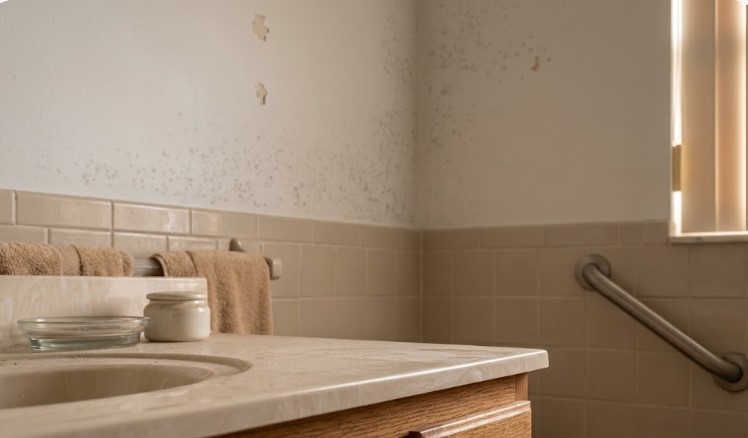
- Mildew and peeling spread across a bathroom that sat closed up with the AC off.
Stains, sagging, or a spreading spot: it’s a leak
Brown tide-line stains, bubbling, a soft or sagging patch, or peeling that runs along an outside wall all point to water coming in from outside the room. In Tampa Bay, the usual sources are:
- Roof leaks after summer storms or hurricane-season wind damage
- Flashing or wall leaks along the roofline, often near windows
- Plumbing from a bathroom or water line above
This isn’t a paint problem. The leak gets fixed first, the ceiling dries out and gets repaired, and only then does it get painted.
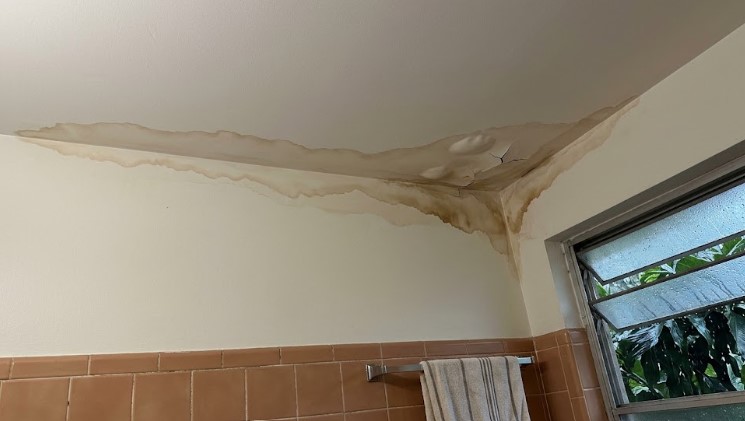
- Water stains and bubbling paint along an outside corner after a summer storm, next to a rain-streaked jalousie window.
Frequently asked questions
Why is paint peeling around the AC vent in my bathroom ceiling?
Cold supply air meets warm, humid bathroom air at the grille, and the vent “sweats.” The condensation wets the paint around it until it peels. A very low thermostat setting and high indoor humidity make it worse.
Can my air conditioner cause ceiling paint to peel?
Yes. A sweating supply vent can drip onto the ceiling around it. If it continues after humidity is under control, an HVAC technician should check the vent and duct.
Should I turn my AC off when I leave my Florida home for the season?
No. With the AC off, indoor humidity climbs quickly, and bathrooms are hit first. Leave it on at a moderate setting, or use a dehumidifier.
Can you paint over peeling bathroom ceiling paint?
No. The new coat peels with the old one unless the cause is fixed and all loose paint is scraped off and primed first.
What paint works best on a Florida bathroom ceiling?
A moisture- and mildew-resistant paint in satin or semi-gloss, over a good primer. The finish matters more than the shade, though some mold-resistant colors hide early mildew better than others.
How do I know if the peeling is from a roof leak?
Look for brown tide-line stains, bubbling, or a soft spot, especially along an outside wall or after a storm. Peeling from steam usually has no staining.
Peeling near a vent, or back from a season away?
We’ll find where the damage started, check the fan and vent, and tell you what’s wetting the ceiling before recommending a repaint. We work across Tampa Bay, including Tampa, Brandon, Valrico, Riverview, and Lutz.
Book a free estimate and we’ll take a look.